



- Quick Start: Your First Hockey Bet in 3 Shifts
- Hockey Betting 101: From Puck Line to 'The Over
- Decoding the Markets: Moneyline, Puck Line, Totals & Props
- How Hockey Odds Work
- Step-by-Step: How to Place Hockey Bets on BC Game
- Winning Strategy: The Pre-Game Goalie & Special Teams Check
- The Advanced Stats Iceberg: What Really Wins Games
- Hockey Betting Odds Comparison Table
- Live Betting in Hockey
- Risks and Responsible Hockey Betting
- Time to Hit the Ice
- FAQ
That constant tension is a big reason why BC Game hockey betting attracts players who enjoy fast decisions and sudden shifts. From high-speed NHL and physical KHL to talent-rich Swedish SHL and international tournaments like IIHF World Championships, hockey calendar stays active throughout year. Different leagues bring different styles, pacing, and scoring patterns, which means betting conditions change depending on where the game is played.
This variety is part of what makes hockey betting both challenging and practical. There is almost always another matchup, another market, and another situation to analyze, allowing bettors to focus on structure instead of forcing action on a limited schedule.
Unlike slower sports, hockey does not give much time to think. Shifts are short, pressure builds quickly, and momentum swings without warning. A team can dominate puck possession for long stretches and still fall behind after a single mistake. From a betting perspective, that means surface logic often breaks down.
This guide is not here to sell excitement. It exists to explain how hockey betting actually works. What markets are available. Why odds behave the way they do. Where preparation helps, and where randomness simply takes over. Ice hockey rewards awareness more than confidence, and the sections below focus on that reality.
Another reason hockey betting feels unique is how much influence small details carry. The starting goalie matters. Special teams matter. Even how a team handles defensive-zone faceoffs can quietly shape the outcome. These factors rarely show up in highlight clips, yet they decide bets more often than star names.
What follows is a clear, practical breakdown. No promises. No shortcuts. Just mechanics, structure, and honest limits.

Last used 6 minutes ago
Quick Start: Your First Hockey Bet in 3 Shifts
If you want to get started without overthinking the process, the first hockey bet on BC.Game can be pIf you want to get started without overthinking the process, the first hockey bet on BC.Game can be placed in just a few simple actions. Think of it as your opening shift — quick, structured, and focused on the essentials:
⏱️ First Shift: Place a Bet in 3 Steps:
- Log in to your BC.Game account, open the Sports section, and find Ice Hockey in the list.
- Choose a major league such as NHL, KHL, or SHL. Open a matchup (for example, Colorado Avalanche vs. Tampa Bay Lightning).
- Click the Moneyline odds for your selected team, enter your stake (for example, $10), and confirm the bet. Puck drop — you’re in.
This basic flow covers the mechanical side of hockey betting. Once the first wager is placed, the real value comes from understanding how markets work, how odds move, and which details actually influence results.
Hockey Betting 101: From Puck Line to ‘The Over

Hockey betting is the practice of placing wagers on outcomes connected to ice hockey games. At the most basic level, that means choosing which team wins a match. Beyond that, the sport offers markets built around scoring, margins, and specific game conditions.
Hockey has its own betting language. Low-scoring games mean each goal carries weight. One bounce can decide everything. Because of that, sportsbooks use specialized markets like the puck line and half-goal totals to avoid draws and force clear outcomes.
Another important detail is how game completion is defined. Many bets include overtime and shootouts by default. Others count regulation time only. Missing this distinction is one of the most common mistakes among new bettors.
Hockey betting also leans heavily on context. Goaltending changes, travel fatigue, and matchup style often matter more than raw standings. Understanding these layers makes later decisions feel less random and more intentional.
Learning the foundation first prevents confusion once odds and markets start moving quickly.
Decoding the Markets: Moneyline, Puck Line, Totals & Props
Hockey betting markets exist because game itself is unpredictable. Some markets focus on final result. Others focus on how game unfolds rather than who wins.
To make these options easier to understand at a glance, table below summarizes core hockey betting markets and key factors that usually influence each one. Think of it as a quick reference sheet before diving into detailed explanations.
| Market | What You Bet On | Example | Key Factor | Risk |
|---|---|---|---|---|
| Moneyline | Straight winner (incl. OT/SO) | Maple Leafs @ 1.65 | Starting goalie, 5v5 play | Medium |
| Puck Line (-1.5) | Favorite wins by 2+ goals | Avalanche -1.5 @ 2.20 | Offensive depth, power play % | High |
| Puck Line (+1.5) | Underdog loses by 1 or wins | Senators +1.5 @ 1.70 | Defensive structure, penalty kill % | Low–Medium |
| Totals (O/U 5.5) | Total goals over/under line | Over 5.5 @ 1.90 | Team tempo, goaltending form | Medium |
| Period Betting | Winner or total for a single period | 1P: Over 1.5 Goals | Early game strategy | Very High |
Each market reflects a different way to read same game. Some focus on final result, others on scoring patterns or short segments of play. Sections below explain how these markets behave in practice and when each one makes most sense.
Core options include moneyline bets, puck line spreads, totals, and various proposition bets depending on league. Each market answers a different question about same match.
Choosing right market is often more important than choosing right team. A favorite may be obvious, but price may not justify risk. In other cases, margin or total offers a clearer angle. Experienced bettors usually learn which markets suit their thinking style instead of chasing everything available.
Moneyline Betting
Moneyline betting in hockey looks simple on surface, and that simplicity is exactly why many people start here. You pick team that wins game, and that is it. No math around margins, no worrying about exact scores. If team survives regulation and gets through overtime or a shootout, bet lands.
Underneath that clarity, however, sits a fair amount of tension. Hockey is a low-scoring sport, which means a single goal often carries outsized importance. A team can be outshot, outskated, and still stay alive until the final horn. That reality keeps underdogs relevant much longer than in many other sports.
Odds in the moneyline market reflect perception rather than certainty. Strong teams come with shorter prices because they win more often. Weaker sides pay more because they lose more often. Goalie confirmations play a huge role here. A late change in net can move the line quickly, sometimes more than any other piece of news.
Moneyline betting rewards patience and selectivity. It works best when price and situation align, not when a favorite simply looks “better.” Many experienced bettors pass on games where the outcome feels obvious but the odds offer little room for error. In hockey, even the cleanest matchup can turn messy without warning.
Puck Line (Spread) Betting

Puck line betting adds pressure where moneyline removes it. Instead of asking who wins, this market asks how they win. Most puck lines sit at ±1.5 goals, which immediately changes the nature of the bet. Favorites must dominate. Underdogs only need to survive.
This structure injects volatility into every decision. A team leading by one late in third period creates tension that does not exist in moneyline betting. An empty-net situation can flip everything in seconds. One clearance attempt becomes difference between winning and losing wager.
Puck line outcomes are often shaped by coaching philosophy. Some teams press aggressively when ahead, hunting insurance goals. Others fall back, protect the slot, and play the clock. Those tendencies matter more than overall rankings or star power.
This market favors bettors who pay attention to behavior, not reputation. Knowing how a team handles late leads, power plays, or defensive-zone pressure provides an edge that standings never show. Puck line betting is less forgiving, but for those who read game flow well, it often feels more honest than moneyline pricing.
Totals (Over/Under) Betting
Totals betting focuses on the combined number of goals scored by both teams. Lines such as 5.5 exist to prevent ties. Strong goaltending, disciplined defense, and slow tempo push games under the total. Power-play efficiency, penalties, and aggressive forechecking push numbers higher. Totals appeal to bettors who read flow rather than reputation. It is less about who wins and more about how the game feels.
Last used 6 minutes ago
How Hockey Odds Work
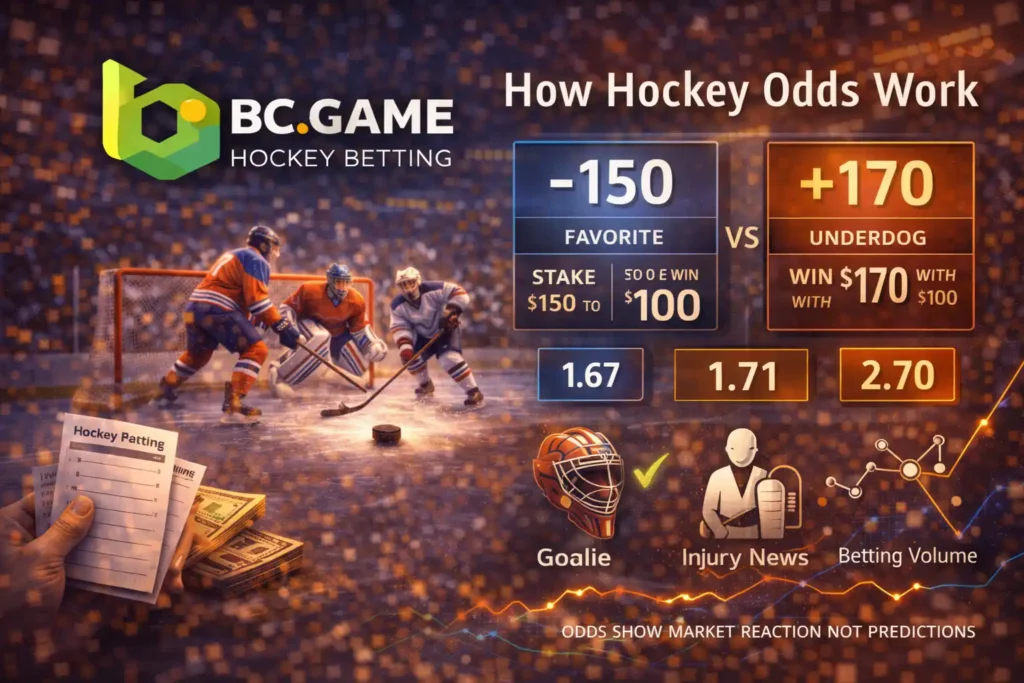
Hockey odds express probability under pressure. Because goals are scarce, small changes in expectation cause noticeable line movement. American odds are commonly used. A minus sign marks a favorite and shows how much must be staked to win a fixed amount. A plus sign marks an underdog and shows potential profit. Decimal odds may also appear for clarity.
Odds shift due to goalie confirmations, injury news, and betting volume. Understanding why a line moves often matters more than the number itself. Odds are not predictions. They are reactions.
Step-by-Step: How to Place Hockey Bets on BC Game
Placing a hockey bet on BC.Game follows a clear interface flow. Knowing where each element is located helps avoid mistakes and speeds up the process, especially when odds are moving.
Step-by-Step: Placing a Hockey Bet on BC Game:
- After logging in, click Sports icon (usually shown as a soccer ball or trophy) in main navigation.
- In A–Z sports menu on the left, find and select Ice Hockey. A list of live and upcoming games will appear, sorted by league.
- Click any matchup line (for example, Boston Bruins vs. Toronto Maple Leafs). Central panel will open with all available betting markets.
- Click odds for your chosen option (for example, Moneyline: Bruins @ 1.75). Selection will automatically appear in bet slip on right side of screen.
- In bet slip, enter your stake amount. “To Win” field updates instantly. Review details and press green Place Bet button to confirm..
A quick review before confirming helps prevent common errors such as selecting the wrong market or missing a line change. After placing a bet, odds are locked and wager appears in open bets section for tracking.
Last used 6 minutes ago
Winning Strategy: The Pre-Game Goalie & Special Teams Check

Most hockey bets are decided before the puck drops. The difference between a random pick and a structured decision usually comes down to a few key checks that reveal fatigue, lineup risk, or hidden value in the odds. Running through a short routine before every game helps reduce emotional betting and keeps the focus on real factors.
✅ Your Pre-Faceoff Checklist (The 5 Must-Checks):
- Goalie Confirmation (Morning Skate) – Who’s in net? Starting goaltenders are the biggest single line-mover in hockey betting.
- The B2B Trap – Is one team playing on a back-to-back? Fatigue usually shows up late, especially in the third period.
- Special Teams Form – Check recent power play and penalty kill performance (last 10 games). Tight matchups are often decided here.
- Home Ice vs. Road Splits – Some teams dominate at home but struggle away. Always compare location performance.
- Line Movement – Did the puck line shift (for example, from −1.5 to −1.0)? Sharp money or late information may be driving the change.
This checklist does not guarantee the right pick, but it filters out many avoidable mistakes. Over time, consistent preparation matters more than prediction, especially in a sport where small edges often decide the final result.
The Advanced Stats Iceberg: What Really Wins Games
Basic analysis helps, but hockey often turns on details that never appear in standings or highlight reels. Advanced metrics show how a team actually plays — who controls the puck, who creates real chances, and where hidden advantages exist.
📊 Beyond Wins & Losses: Key Metrics for Sharp Bettors:
- Special Teams Differential: (Power Play % minus Penalty Kill %). A team with a +10% edge often decides tight games through special teams.
- Corsi / Fenwick (Shot Attempts %): Measures puck possession and sustained pressure. Numbers above 52% usually indicate territorial control.
- High-Danger Scoring Chances (HDSC): More important than total shots. This shows which team creates real scoring opportunities from dangerous areas.
- Goalie Save Percentage (SV%) & Goals Saved Above Average (GSAA): Helps identify whether a goalie is in strong form or quietly costing the team games.
These numbers add context that basic statistics miss. Reliable data is available on platforms such as Natural Stat Trick, MoneyPuck, or official league statistics pages. Used together, advanced metrics help separate short-term results from underlying performance and make betting decisions feel less dependent on guesswork.
Hockey Betting Odds Comparison Table
Odds feel abstract until they are placed next to real numbers. Seeing how different hockey markets translate into potential payouts helps connect theory to practice. The table below shows simple examples using common bet types and a standard stake:
| Bet Type | Odds (US) | Payout on $100 | Implied Prob. | Odds (Decimal) |
|---|---|---|---|---|
| ML Favorite | -150 | $166.67 | 60.0% | 1.67 |
| ML Underdog | +130 | $230.00 | 43.5% | 2.30 |
| Puck Line (-1.5) | -110 | $190.91 | 52.4% | 1.91 |
| Totals Over 5.5 | -105 | $190.48 | 51.2% | 1.95 |
This table highlights balance, not opportunity. Negative odds show how much is required to win a fixed amount. Positive odds show potential profit on a standard stake. Decimal equivalents can be calculated easily for comparison.
Understanding payout structure removes guesswork. Once the math feels familiar, decisions shift back to analysis instead of calculation. That clarity helps keep emotions out of the process.
Last used 6 minutes ago
Live Betting in Hockey

Live betting cLive betting changes the entire rhythm of hockey wagering. Before puck drop, everything is projection. Once the game starts, betting becomes interpretation. Momentum shifts quickly, sometimes within a single shift, and the market reacts in real time.
Odds adjust immediately after goals, penalties, goalie changes, or extended pressure without scoring. A team may trail on the scoreboard while controlling possession. Another may lead but spend long stretches defending. Live markets try to price that tension as the game unfolds.
Watching the game with a few structured scenarios in mind makes live betting more controlled and less emotional. Instead of reacting to every change, experienced bettors focus on specific situations where the odds may move faster than the actual game dynamics:
Spotting Live Betting Opportunities:
- The Goalie Change – A starting goalie is pulled after allowing two quick goals. The underdog’s Moneyline price shortens quickly. The key question is whether the shift reflects real momentum or a short-term market overreaction.
- The Power Play Momentum – One team receives a long advantage, such as a five-minute major. Team totals and game totals rise. This situation only creates value if the power play unit is efficient and capable of sustained pressure.
- “Dominant but Losing” Team – Despite a 1–0 score, trailing side heavily outshoots opponent and controls zone time. Live Moneyline or +1.5 puck line odds may become attractive if the territorial advantage continues.
Live betting rewards attention to structure rather than emotion. Shot quality, puck possession, defensive breakdowns, and bench reactions often matter more than the current score. Timing is critical: acting too early means chasing noise, while waiting too long may close the opportunity. Goal is not constant action. In live hockey betting, advantage comes from patience and from recognizing moments where game flow and market briefly move out of balance.
Risks and Responsible Hockey Betting
Hockey betting carries risk that is easy to underestimate. The sport feels familiar, games are frequent, and odds often look reasonable. That combination can quietly encourage overconfidence.
Variance plays a large role. A deflected shot, a bad bounce, or a screened goalie can undo solid analysis. Emotional risk compounds the problem. Chasing losses or betting simply because a game is on usually leads to poor decisions.
Responsible betting starts with limits. Financial limits matter, but mental ones matter just as much. Knowing when to skip a slate, even when games look appealing, protects long-term balance.
Tracking bets helps reveal habits. Taking breaks helps reset perspective. Treating wagers as optional choices rather than routine actions keeps control intact. Hockey rewards patience. It punishes urgency. Accepting that reality makes betting sustainable rather than stressful.
Time to Hit the Ice
Hockey betting is a sport within a sport. Small margins, momentum swings, and one key save can change everything in seconds. Now you understand how the main markets work, why odds react to goaltenders and special teams, and how structured preparation matters more than simply trusting the standings.
Theory only becomes useful when it turns into careful action. The goal is not to chase excitement, but to apply discipline, use your checklist, and treat each wager as a decision rather than a reaction.
Start with a small Moneyline bet on a game you’ve analyzed in advance. Run through your pre-faceoff checklist, note why you made choice, and track outcome. In hockey, success rarely comes from predicting every bounce. It comes from being prepared for game behind game — and staying consistent shift after shift.